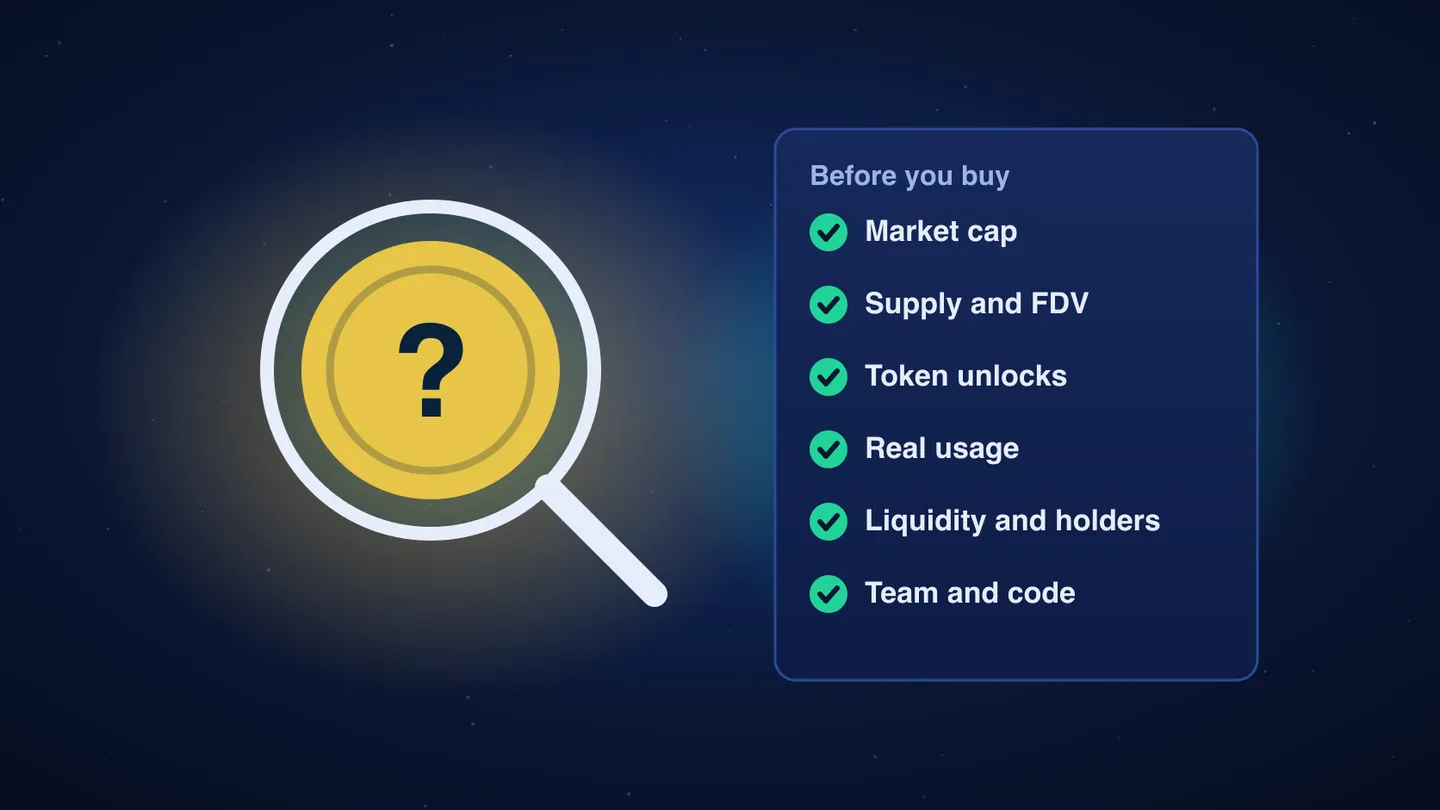
1. Price means nothing. Market cap is what counts.
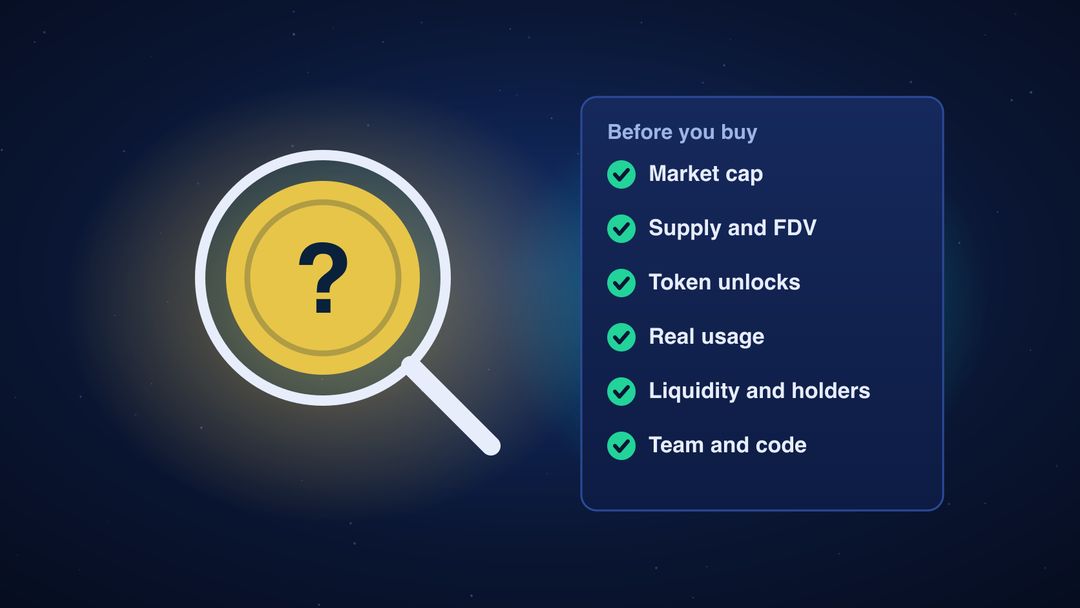
A coin at $0.001 isn’t “cheap,” and one at $500 isn’t “expensive.” Market cap (price × circulating supply) tells you how big the project is. Going from $1B to $10B is a very different challenge than going from $10M to $100M. Ask yourself whether the coin can realistically grow that much. (More on this in What market cap really tells you.)
2. Know your three supplies
- Circulating supply: coins trading right now.
- Total supply: everything that exists, including locked coins.
- Max supply: the hard cap, if there is one (Bitcoin: 21M).
The trap is a low market cap with a huge gap between circulating and total supply. Check the fully diluted valuation (FDV), which is the market cap if all coins were out. If FDV is 10x the market cap, 90% of the supply is still waiting to hit the market.
3. Study the release schedule
This is the most overlooked factor. Look at the token unlock calendar (tokenomics pages or sites like Token Unlocks). Big unlocks for the team and early investors often crash the price, because insiders bought at a fraction of your price and many are happy to sell.
- Good signs: long vesting (3–4 years), a small team allocation, and a fair distribution.
- Red flags: 30%+ held by insiders and cliff unlocks in the coming months.
4. Does it actually do something?
Ask what problem it solves and whether anyone uses it. Check real activity such as daily active users, transaction counts, and fees or revenue the protocol generates (DefiLlama is great for this). A coin with a great story and zero users is just a story.
5. Liquidity and holders
- Volume: if daily volume is tiny compared to market cap, you may struggle to sell.
- Listings: trading only on obscure exchanges is a warning sign.
- Holder distribution: if the top 10 wallets hold most of the supply, a few people can move the price or dump on you.
6. The team and the code
Are the founders public with a real track record, or anonymous? Anonymous doesn’t always mean bad (Satoshi!), but it removes accountability. Check for security audits and for GitHub activity. A project with no commits in six months is probably dead.
7. Social media: a signal, not a verdict
Use it to gauge community health, not to make decisions. Look for real discussion, developers who answer questions, and steady growth. Be suspicious of sudden follower spikes, bot-like comments, paid “influencer” shilling, and hype with no technical substance. When everyone on your feed is screaming about a coin, you’re usually late.
8. Your own rules
- Only invest what you can afford to lose. Most small coins go to zero.
- Never put everything in one coin.
- Decide your exit plan before you buy, both for profit and for loss.
- If you can’t explain in two sentences why you’re buying, don’t.
The takeaway
Analyzing a coin is like investigating a startup that has no legal obligation to be honest with you. The numbers (supply, unlocks, distribution) are harder to fake than the marketing. Most people check the price chart and the hype, while the winners check who’s holding, who’s selling, and when.
This is education, not financial advice, and even a perfect analysis can’t protect you from a market that turns overnight.