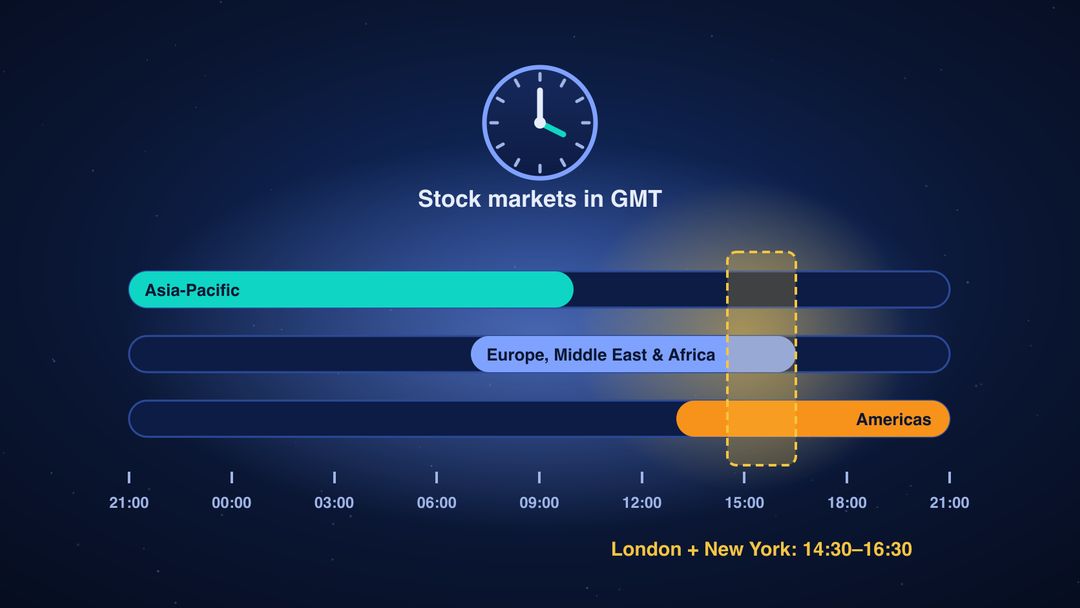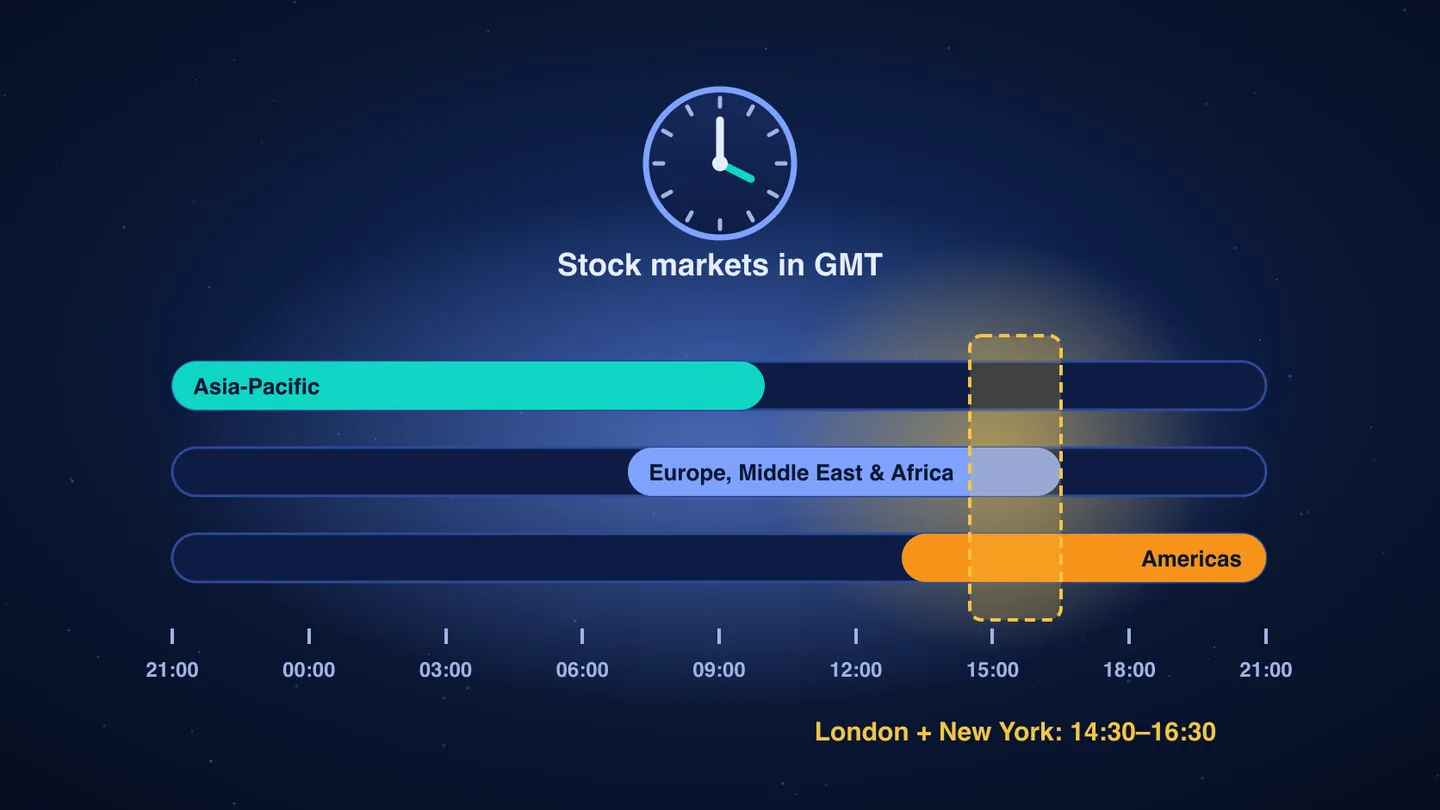
Stocks trade somewhere on Earth almost around the clock on every weekday. Wellington opens the day at 21:00 GMT, and Wall Street closes it at 21:00 GMT the next evening.
Below is every major exchange with its local hours and the same session in GMT, so you can convert once to your own time zone and stop guessing.
One warning before you read: clocks are moving right now. Europe left summer time on 25 October, and the US follows on 1 November. All GMT times below are the winter schedule, valid from 2 November 2026 until March 2027. Summer-time differences are listed at the end.
Americas
The Americas close the global day, and almost all of them sync to New York.
- USA – NYSE & Nasdaq (New York): 09:30–16:00 ET → 14:30–21:00 GMT. Pre-market 04:00–09:30 ET (09:00–14:30 GMT), after-hours 16:00–20:00 ET (21:00–01:00 GMT).
- Canada – TSX (Toronto): 09:30–16:00 ET → 14:30–21:00 GMT
- Mexico – BMV (Mexico City): 08:30–15:00 local → 14:30–21:00 GMT
- Brazil – B3 (São Paulo): 10:00–17:55 BRT from 3 November → 13:00–20:55 GMT. B3 stretches its close by 55 minutes every US winter to stay aligned with Wall Street.
Europe, Middle East & Africa
Most of continental Europe trades 09:00–17:30 local time, which in winter is 08:00–16:30 GMT, the same window as London.
- UK – LSE (London): 08:00–16:30 GMT → 08:00–16:30 GMT
- Euronext (Paris, Amsterdam, Brussels, Milan, Dublin): 09:00–17:30 CET → 08:00–16:30 GMT. Lisbon trades the same session at 08:00–16:30 local.
- Germany – Xetra (Frankfurt): 09:00–17:30 CET → 08:00–16:30 GMT
- Switzerland – SIX (Zurich): 09:00–17:30 CET → 08:00–16:30 GMT
- Spain – BME (Madrid): 09:00–17:30 CET → 08:00–16:30 GMT
- Poland – GPW (Warsaw): 09:00–17:00 CET → 08:00–16:00 GMT
- Turkey – Borsa Istanbul: 10:00–18:00 TRT → 07:00–15:00 GMT
- Saudi Arabia – Tadawul (Riyadh): 10:00–15:00 AST, Sunday to Thursday → 07:00–12:00 GMT
- South Africa – JSE (Johannesburg): 09:00–17:00 SAST → 07:00–15:00 GMT
Asia-Pacific
Asia opens the trading day while Europe sleeps, and several markets still pause for lunch.
- New Zealand – NZX (Wellington): 10:00–16:45 NZDT → 21:00–03:45 GMT (starts the previous evening in GMT)
- Australia – ASX (Sydney): 10:00–16:00 AEDT → 23:00–05:00 GMT (starts the previous evening in GMT)
- Japan – TSE (Tokyo): 09:00–11:30 and 12:30–15:30 JST → 00:00–02:30 and 03:30–06:30 GMT
- South Korea – KRX (Seoul): 09:00–15:30 KST → 00:00–06:30 GMT
- Taiwan – TWSE (Taipei): 09:00–13:30 local → 01:00–05:30 GMT
- China – SSE & SZSE (Shanghai, Shenzhen): 09:30–11:30 and 13:00–15:00 CST → 01:30–03:30 and 05:00–07:00 GMT
- Hong Kong – HKEX: 09:30–12:00 and 13:00–16:00 HKT → 01:30–04:00 and 05:00–08:00 GMT
- Singapore – SGX: 09:00–17:00 SGT, no lunch break → 01:00–09:00 GMT
- India – NSE & BSE (Mumbai): 09:15–15:30 IST → 03:45–10:00 GMT
The trading day in GMT, and the overlaps that matter
The busiest hours of the global day are 14:30–16:30 GMT, when London and New York are open together.
- 21:00 – Wellington opens
- 23:00 – Sydney opens
- 00:00 – Tokyo and Seoul open
- 01:30 – Shanghai and Hong Kong open
- 03:45 – Mumbai opens
- 07:00 – Istanbul, Riyadh and Johannesburg open; Tokyo and Shanghai are closed
- 08:00 – London, Frankfurt and Paris open; Hong Kong closes
- 10:00 – Mumbai closes
- 14:30 – New York and Toronto open: the London–New York overlap begins
- 16:30 – London and Europe close
- 21:00 – New York closes, and Wellington opens again
Three windows worth knowing:
- London + New York (14:30–16:30 GMT): the deepest liquidity of the day, and when US data releases hit European prices.
- Asia → Europe handover (07:00–08:00 GMT): Asia’s closing moves get priced into the European open.
- The quiet gap (21:00–23:00 GMT): only New Zealand and US after-hours trading are live.
Daylight saving, and what changes on 6 December
Local hours never move; the GMT times do, whenever a country changes its clocks.
- Between the two clock changes (26–30 October 2026): Europe is already on winter time but the US is not, so New York opens at 13:30 GMT and the London–New York overlap runs three hours instead of two.
- US summer time (from 14 March 2027): New York, Toronto and Mexico City trade 13:30–20:00 GMT; São Paulo shortens its session again.
- European summer time (from 28 March 2027): London and the continent shift one hour earlier, to 07:00–15:30 GMT.
- Southern hemisphere (from 4 April 2027): Sydney moves to 00:00–06:00 GMT and Wellington to 22:00–04:45 GMT.
- No clock changes: Japan, China, Hong Kong, Korea, Taiwan, Singapore, India, Turkey, Saudi Arabia and South Africa keep the same GMT times all year.
The big one: Wall Street goes (almost) 24 hours. Nasdaq and NYSE Arca are targeting 6 December 2026 for 23-hour trading, five days a week, still subject to SEC approval and data-feed readiness. The new overnight session runs 21:00–04:00 ET, Sunday to Thursday, which is 02:00–09:00 GMT. Once it is live, US stocks will trade during the Asian and European mornings, and the only pause will be one hour each night.
Trading hours can change for holidays and special sessions. Check the exchange’s own calendar before you trade.