Overview
Ethereum is the second-largest cryptocurrency and the blockchain where most of crypto’s “applications” live: decentralized exchanges, lending markets, stablecoins, NFTs and tokenized funds. It launched in July 2015, based on an idea by Vitalik Buterin, who described it as a “world computer” that anyone could program.
While Bitcoin was built mainly as digital money, Ethereum was built as a platform. Developers write smart contracts, programs that run on the blockchain exactly as written, and anyone can use them without asking permission. The network’s coin, ether (ETH), pays for running those programs and secures the network.
There is no company behind Ethereum. Development is shared among independent teams around the world, supported by the non-profit Ethereum Foundation.
How it works
Ethereum runs on proof of stake. Since an upgrade called the Merge in September 2022, blocks are no longer produced by energy-hungry mining computers, but by validators. These are participants who lock up (“stake”) at least 32 ETH as a guarantee of good behavior. Validators who cheat lose part of their stake. The switch cut Ethereum’s energy use by more than 99.9%.
Each transaction pays a fee, called gas. Part of every fee is burned (permanently destroyed), which offsets the new ETH paid to validators. When the network is very busy, more ETH is burned than created and the supply shrinks; when it is quiet, the supply grows slightly.
Layer 2 networks
The main Ethereum network (Layer 1) handles only a limited number of transactions, so fees can rise when demand is high. Ethereum’s answer is Layer 2 networks, or “rollups”, such as Base, Arbitrum and Optimism. They process transactions on their own, very cheaply, and then post the results back to Ethereum, which keeps them secure.
This has worked: a transfer on a Layer 2 usually costs a cent or less. The downside is fragmentation. Users, apps and money are spread across dozens of separate networks, and moving between them is still clumsy. Critics also argue that Layer 2s capture much of the value that would otherwise go to Ethereum itself.
Upgrades in 2025–2026
Ethereum improves through regular, carefully tested upgrades:
- Pectra (May 2025) made wallets smarter — for example, letting users pay fees in tokens other than ETH or bundle several actions into one — and let large validators stake up to 2,048 ETH.
- Fusaka (December 2025) introduced PeerDAS, which lets nodes check Layer 2 data by sampling small pieces instead of downloading everything. Follow-up steps raised capacity further, making Layer 2s even cheaper.
- Glamsterdam (next) aims to speed up the main network itself and to raise how many transactions each block can hold. It went live on the Sepolia test network on 6 October 2026 and is scheduled for the Hoodi test network on 26 October. No mainnet date has been set yet; developers are targeting late 2026.
The ETH token
| ETH at a glance | |
|---|---|
| Supply (Oct 2026) | about 122 million ETH |
| Maximum supply | none (no fixed cap) |
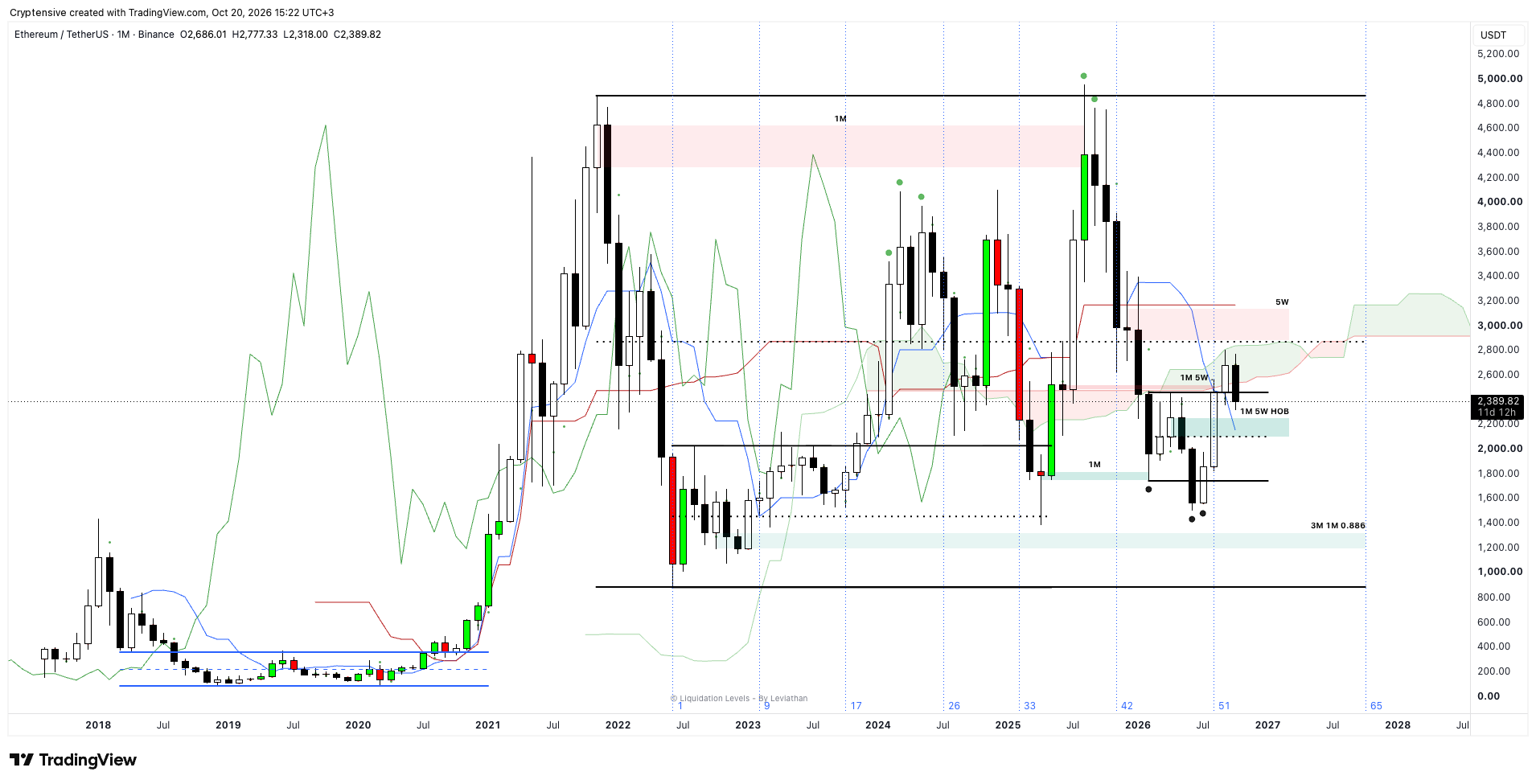
| Price (20 Oct 2026) | about $2,380 |
| All-time high | about $4,950 (August 2025) |
| Market cap | about $290 billion (#2) |
| Staked | roughly a third of all ETH |
ETH has no maximum supply, but new issuance is low. Since fees dropped in 2024, less ETH has been burned, and the supply has grown slowly again. This is a common criticism, though the growth is well under 1% a year.
Staking is how ETH holders earn a yield. Roughly a third of all ETH is staked, earning around 3% a year. You don’t need 32 ETH yourself: exchanges and services such as Lido let you stake any amount. Lido alone handles about a quarter of all staked ETH, which some see as too much power in one place.
Wall Street’s favorite blockchain
Ethereum is where traditional finance is experimenting with crypto:
- ETFs. US spot ether ETFs have traded since July 2024, and newer funds, including one from BlackRock, now stake part of their ETH. Flows swing with the market: in the first half of October 2026, investors pulled about $715 million out of these funds.
- Treasury companies. Several listed companies hold ETH as their main asset. The largest, BitMine, held about 5.8 million ETH in August 2026, nearly 5% of the entire supply, most of it staked.
- Tokenization. BlackRock’s tokenized money-market fund BUIDL launched on Ethereum, and in 2026 JPMorgan brought its JPM Coin deposit token to the public Ethereum network. Roughly half of all stablecoin dollars also live on Ethereum.
Security and reliability
This is one of Ethereum’s strongest points. In more than ten years, the network has never stopped producing blocks, through market crashes and major upgrades alike. It is also one of the most decentralized smart-contract networks, with around a million validators and several independent software clients, so a bug in one program cannot take the whole network down.
The risks lie mostly in the apps built on top, not in Ethereum itself. Smart contracts can have bugs, and DeFi hacks remain common across the industry. Money deposited in Ethereum’s DeFi apps stood at about $50 billion in October 2026, according to DeFiLlama — still far ahead of any other blockchain, but below the 2021 peak of over $100 billion.
Ethereum vs. the competition
| Ethereum | Bitcoin | Solana | |
|---|---|---|---|
| Launched | 2015 | 2009 | 2020 |
| Main use | Apps, DeFi, stablecoins | Digital money, store of value | Fast, cheap apps and trading |
| Supply | No cap, low issuance | Fixed at 21 million | No cap, inflation decreasing |
| Scaling approach | Layer 2 networks | Lightning (payments) | Single fast chain |
| Network halts | None | None since 2013 | Several, mostly 2021–2023 |
Bitcoin is simpler and has a fixed supply, but cannot run complex apps. Solana is faster and cheaper on its own chain and has taken much of the retail trading activity. Ethereum’s edge is trust: the most money, the most developers and the strongest security record among smart-contract platforms.
Our verdict
Ethereum is the backbone of decentralized finance and the blockchain most trusted by large institutions. Its upgrades keep arriving on a steady schedule, its network has never gone down, and its ecosystem is still the largest by a wide margin.
The concerns are about value, not technology. Activity has spread to Layer 2s and rival chains, the supply is no longer shrinking, and ETH trades about half below its 2025 high. For many investors, ETH is a core long-term crypto holding next to Bitcoin, but it remains volatile and can fall sharply. Invest only what you can afford to lose, and consider keeping your ETH in a wallet you control.
This review is for information only and is not financial advice.