Overview
Avalanche is a Layer 1 blockchain created by Ava Labs, a company founded by Cornell professor Emin Gün Sirer. Its main network went live in September 2020, built on a new way for computers to agree with each other, the Avalanche consensus.
In the 2021 bull market, Avalanche was one of the hottest “Ethereum killers”, with billions of dollars in DeFi. Since then it has reinvented itself around two ideas: letting companies launch their own blockchains on Avalanche, and bringing real-world finance, such as funds and treasury bills, on-chain.
How it works
Most blockchains need every validator to talk to every other validator, which gets slow as the network grows. Avalanche validators instead ask a small random sample of other validators what they think, over and over, until the whole network quickly agrees. The result is that transactions become final in about a second and can’t be reversed.
Avalanche’s main network, the Primary Network, is made up of three chains:
- the C-Chain, where smart contracts and apps run. It is compatible with Ethereum, so the same apps and wallets, such as MetaMask, work on it;
- the P-Chain, which manages validators and custom chains;
- the X-Chain, used for fast transfers of assets.
Avalanche L1s: custom blockchains
Avalanche’s big idea is that each app or company can have its own blockchain, called an Avalanche L1 (previously “subnets”). Each L1 can set its own rules: who may use it, what fees it charges, even which token pays for gas. All of them can still talk to each other.
The Etna upgrade in December 2024 made launching an L1 much cheaper: validators no longer have to lock up 2,000 AVAX each, and pay a small ongoing fee instead. By August 2026, there were around 60 L1s on mainnet, including chains for games such as Off The Grid, for FIFA’s digital collectibles, and for financial companies.
The downside is fragmentation. Activity is spread across many separate chains, and the main C-Chain has become quieter than in the past.
Tokenization and institutions
Avalanche has become one of the leading networks for tokenized real-world assets:
- Large asset managers, including BlackRock (BUIDL), Franklin Templeton and KKR (through Securitize), have put funds on Avalanche.
- Tokenized US Treasuries on Avalanche reached about $545 million in the third quarter of 2026, roughly four times more than at the start of the year.
- Banks and market operators, from Citi and JPMorgan in earlier pilots to the NYSE more recently, have tested Avalanche for tokenization.
The AVAX token
| AVAX at a glance | |
|---|---|
| Maximum supply | 720 million AVAX |
| In circulation (Oct 2026) | about 444 million |
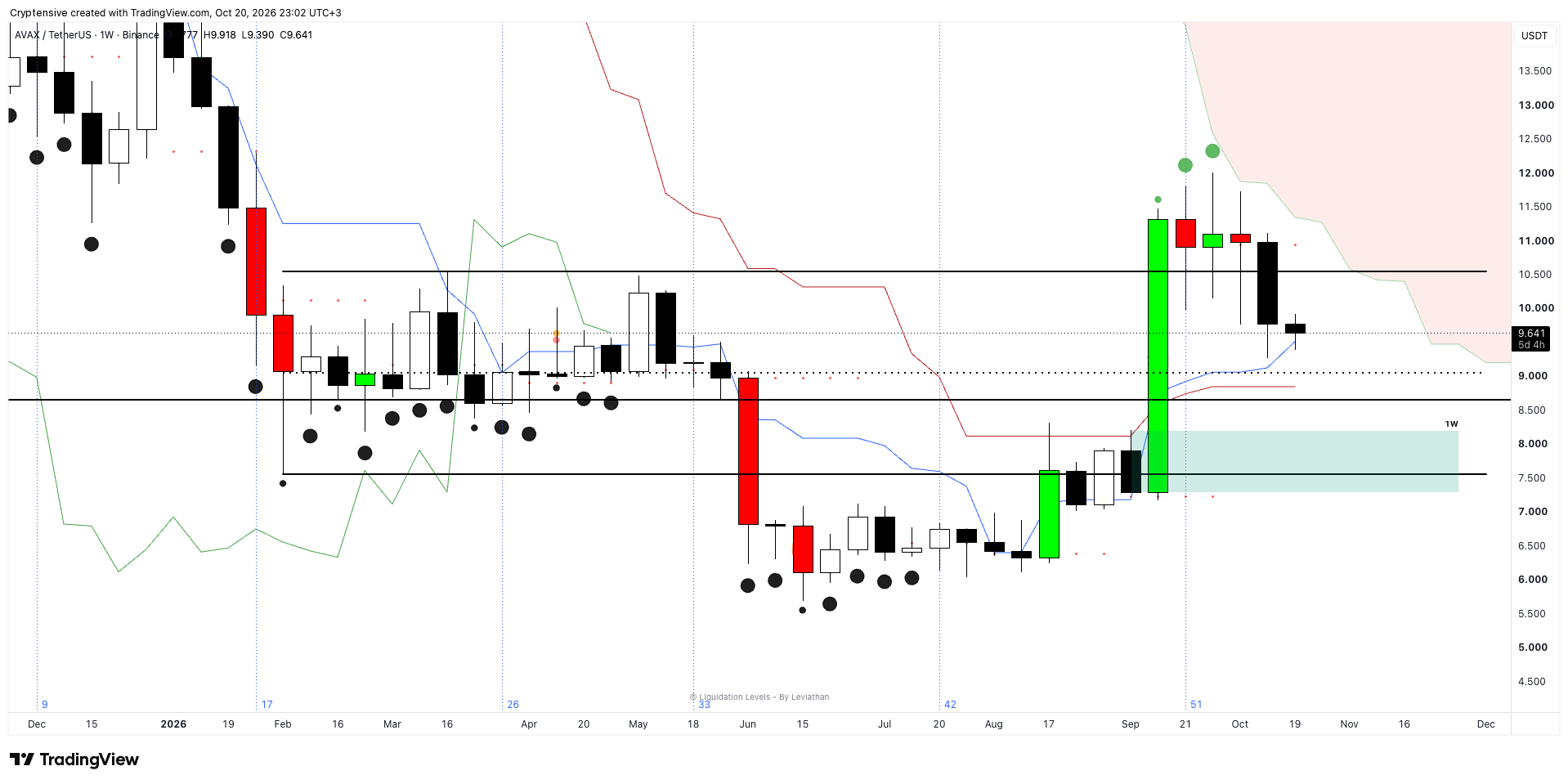
| Price (20 Oct 2026) | about $9.60 |
| All-time high | about $145 (November 2021) |
| Market cap | about $4.3 billion (#27) |
AVAX pays for transactions, is staked to secure the network, and is used by L1s. All transaction fees on the main network are burned, permanently removing AVAX from circulation, although that burn is small while activity is low. New AVAX comes from staking rewards and from scheduled unlocks of tokens set aside for the team, investors and the foundation, which continue every quarter until 2030. The next one is due on 8 November 2026.
Staking is open to everyone: you can delegate from 25 AVAX, or run a validator with 2,000 AVAX. The Helicon upgrade, which went live on 22 September 2026, cut the minimum time a validator must lock its stake from two weeks to 48 hours.
ETFs and treasury companies
- ETFs. Several US spot AVAX ETFs have launched, including funds from Bitwise, Grayscale and VanEck, the latter in January 2026. Inflows have been modest.
- Treasury company. Avalanche Treasury Co. (AVAT) listed on Nasdaq in June 2026 through a roughly $675 million merger, aiming to hold over $1 billion in AVAX. It held about 13.4 million AVAX at the end of March 2026, worth far less than it paid, and its share price has fallen more than 70% since its debut.
Security and reliability
Avalanche’s network has a good overall record. Its most notable problem was on 23 February 2024, when the main network stopped finalizing blocks for about five hours because of a bug triggered by a wave of “inscription” transactions. It was fixed the same day, and no funds were lost.
The bigger concern is usage. Money deposited in DeFi apps on Avalanche stood at about $590 million in October 2026, according to DeFiLlama, down from a peak of $11.5 billion in December 2021. Part of this is the lower AVAX price, but Avalanche has clearly lost DeFi users to Solana, Ethereum’s Layer 2s and newer chains. The Avalanche Foundation presented a new plan in September 2026 to tie the AVAX token more closely to network activity, but details are still emerging.
Avalanche vs. the competition
| Avalanche | Ethereum | Solana | |
|---|---|---|---|
| Launched | 2020 | 2015 | 2020 |
| Scaling approach | Custom L1 chains | Layer 2 networks | One fast chain |
| Finality | About 1 second | About 13 minutes on mainnet | Seconds (faster after Alpenglow) |
| Max supply | 720 million | No cap | No cap |
| Main strength | Custom chains, tokenization | Security, DeFi, institutions | Speed, trading, users |
Ethereum leads in trust and tokenized assets overall, and Solana in everyday activity. Avalanche’s edge is its custom-chain model, which suits companies that want their own blockchain with their own rules, and its fast finality, which banks and payment firms value.
Our verdict
Avalanche has strong technology, a clear niche in custom blockchains, and real momentum in tokenized finance, with well-known asset managers already using it. Faster finality and cheaper L1s make it attractive for businesses.
But the numbers for investors have been painful: AVAX is more than 90% below its 2021 high, DeFi activity has shrunk dramatically, and regular token unlocks continue until 2030. Institutional experiments don’t automatically lift demand for the AVAX token. AVAX is a high-risk recovery bet: invest only what you can afford to lose, and consider keeping your coins in a wallet you control.
This review is for information only and is not financial advice.