
Overview
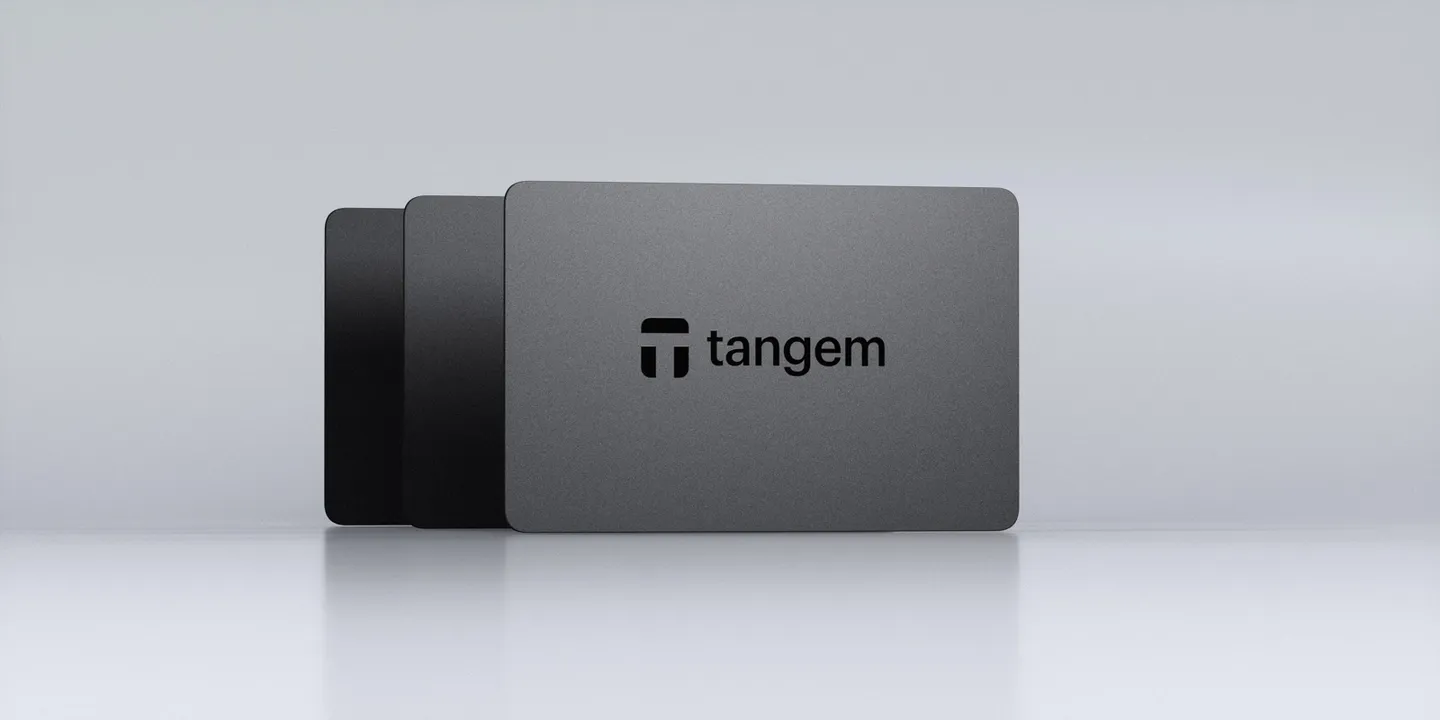
Tangem is a hardware wallet that looks like a bank card. There is no screen, no buttons, no battery and no USB cable: you tap the card on the back of your phone, and the Tangem app talks to it over NFC — the same technology used for contactless payments. The company was founded in 2017 and is headquartered in Switzerland, and it says millions of its cards have been sold.
Its big idea is to make cold storage as simple as paying with a card. For many people the hardest part of a classic hardware wallet is the 12- or 24-word seed phrase they have to write down and protect. Tangem lets you skip it entirely, if you want to.
How it works
Each Tangem card contains a secure element — a tamper-resistant chip of the kind used in passports and bank cards, certified to the EAL6+ security level. When you set up a new wallet, the private key is generated inside the chip and, by design, never leaves it. To send crypto, the app prepares the transaction, you tap the card, the chip signs it and the signed transaction goes back to the phone for broadcasting.
Setup takes a few minutes:
- Install the Tangem app (iOS or Android) and tap your first card.
- Choose an access code — it protects the card if someone else gets hold of it.
- Tap the second (and third) card to create backups. All cards in the set hold the same wallet, and any one of them can be used to sign.
Keep one card in your wallet and the others in safe, separate places — at home, with a family member, in a safe-deposit box. If you lose one card, the others still give you full access.
Seedless vs. seed phrase
By default, there is no seed phrase: the key exists only inside your cards. This removes the most common way people lose crypto — a photographed, stolen or badly stored list of words. The trade-off is that if you lose all your cards, your funds are gone; no one, including Tangem, can recover them.
Current Tangem cards also offer a seed-phrase option. You can generate a seed phrase in the app or import one you already have, which also lets you move the same wallet to another brand of hardware wallet later. Purists should note that a phrase created or imported this way passes through your phone at least once.
Prices
Tangem is one of the most affordable hardware wallets on the market. Approximate prices on the official store in autumn 2026:
| Product | Price |
|---|---|
| Tangem Wallet — 2 cards | ~$55–60 |
| Tangem Wallet — 3 cards (recommended) | ~$70 |
| Family Pack — 6 cards | ~$140 |
| Tangem Ring + backup cards | ~$150–160 |
Prices change often and there are frequent discounts, so check the official store. Shipping is free above a minimum order value. Buy only from tangem.com or an official reseller — never a second-hand card.
The Tangem Ring works the same way as the cards, but you wear it on your finger and tap it on your phone. It is water-resistant and made of ceramic and steel, but it is pricier and best paired with backup cards.
The app and supported assets
The Tangem app is the only interface. It supports thousands of coins and tokens across dozens of networks, including Bitcoin, Ethereum and EVM chains, Solana, XRP, Cardano, TON and Tron. In the app you can:
- see your portfolio and send or receive crypto;
- buy and sell crypto through partner providers;
- swap between coins, including cross-chain swaps;
- stake some assets, such as Solana, Cosmos or Polkadot;
- connect to DeFi apps through WalletConnect.
Buying, selling and swapping go through third-party partners, whose fees and spreads can be noticeably higher than on an exchange — compare before you use them. The app itself, and the cards, have no subscription or hidden fees.
Security
Tangem has strong points: the keys are created in a certified chip, there is no USB connection to attack, the cards are waterproof (IP68) and come with a 25-year warranty. The mobile app is open source, and the card firmware was audited by Kudelski Security in 2018 and Riscure in 2023.
There are also points every buyer should know:
- The card firmware is closed source. You have to trust the audits and the company, since independent experts cannot fully review the code. Ledger is in a similar position; Trezor is fully open source.
- The firmware cannot be updated. Tangem presents this as a security feature — no one can push malicious firmware to your card — but it also means flaws cannot be patched.
- No screen on the card. You confirm transactions on your phone, so you rely on the phone showing the correct address. Ledger and Trezor show it on the device itself, which protects you better if your phone is compromised.
- The 2026 laser attack. In July 2026, Ledger’s security team (Donjon) showed that a card can be reset with a laser fault-injection attack, giving the attacker control of the wallet. It needs physical possession of the card, about $250,000 of lab equipment, expert skills and hours of work, and it visibly damages the card. Tangem calls the risk to everyday users “virtually non-existent”. In practice: for normal amounts it is not a realistic threat, but if a card is lost or stolen, move your funds to a new wallet using your backup cards.
Pros and cons
Pros
- Very easy to use — no cables, no charging, nothing to plug in.
- No seed phrase to write down or lose (optional).
- Built-in backup with 2–3 identical cards.
- Cheap, slim and tough: waterproof, no battery, 25-year warranty.
- Wide coin support, with swaps, staking and DeFi in one app.
Cons
- Phone-only — no desktop app.
- No screen on the device to verify addresses.
- Closed-source firmware that cannot be updated or patched.
- In seedless mode, losing every card means losing your funds.
- Partner fees for buying and swapping can be high.
Tangem vs. the competition
| Tangem | Ledger Nano X | Trezor Safe 3 / Safe 5 | |
|---|---|---|---|
| Price | ~$55–70 (2–3 cards) | ~$150 | ~$80 / ~$170 |
| Connection | NFC, phone | Bluetooth / USB | USB |
| Screen | No | Yes | Yes |
| Seed phrase | Optional | Required | Required |
| Open-source firmware | No | No | Yes |
| Firmware updates | No | Yes | Yes |
Ledger offers the widest app ecosystem and an on-device screen, but you must manage a seed phrase and it costs more. Trezor is the choice for people who value fully open source code and a desktop experience. Other budget options, such as Keystone or SafePal, add screens and QR-code signing but lose some of Tangem’s simplicity.
Who it’s for
Tangem is an excellent choice for beginners and everyday holders who want real self-custody without the stress of a seed phrase or the hassle of cables — and for anyone who wants a backup they can hand to a family member. It is a natural first step off an exchange.
Advanced users and people storing very large sums may prefer a device with a screen and updatable, open-source firmware, such as a Trezor — or use Tangem alongside one.
Verdict
Tangem is the simplest hardware wallet we know of. It is cheap, tough and genuinely easy to use, and its multi-card backup solves the seed-phrase problem in a clever way. The lack of a screen and the closed, non-updatable firmware are real trade-offs, but for most people storing everyday amounts, Tangem offers a big step up in security over leaving crypto on an exchange.